A comprehensive guide for Singapore businesses, training providers, HR professionals and educational institutions.
Introduction: Understanding the Learning Management System
A Learning Management System (LMS) is a digital platform that enables organisations to create, deliver, manage, track and evaluate learning and training activities through a centralised system.
In Singapore, LMS platforms are used by companies, government agencies, educational institutions and private training providers to support employee training, professional development, compliance training, skills upgrading and online education.
As organisations increasingly adopt digital learning and blended training approaches, an LMS has become an important component of workforce development and organisational learning.
Rather than relying entirely on classroom training, spreadsheets, email and manual attendance records, an LMS allows organisations to manage learning activities digitally, from course creation and learner enrolment to assessments, certification and training reports.
For Singapore training providers, a modern LMS can also form part of a broader Training Management System (TMS) environment, supporting course administration and integration with relevant government systems, including Training Partners Gateway (TPGateway), where applicable.
This guide explains what an LMS is, how it works, the different ways it is implemented in Singapore, and what organisations should consider when selecting an LMS.
What Is a Learning Management System (LMS)?
A Learning Management System is software designed to manage the complete learning process within an organisation.
It provides a central platform where administrators, trainers and learners can access the tools and resources they need to conduct and participate in training.
1. Create learning content. Develop online courses, upload training materials, create interactive lessons, and build quizzes or assessments.
2. Manage learners and training. Register users, assign courses, manage enrolments, organise training schedules and track learner progress.
3. Deliver online and blended learning. Provide self-paced online learning, instructor-led training support and blended learning that combines digital and classroom activities.
4. Assess learner competency. Conduct online examinations, quizzes, assignments, practical assessments and competency-based evaluations.
5. Track learning and certification. Monitor course completion, assessment results, attendance records and training certificates.
6. Analyse training performance. Generate reports on learner participation, course completion, assessment outcomes and training effectiveness.
In simple terms, an LMS helps organisations move from managing training activities manually to managing learning through a structured digital platform.
What is the difference between an LMS and a TMS?
| System | Primary purpose |
|---|---|
| Learning Management System (LMS) | Focuses on learning delivery, course content, learner engagement, assessments and learning outcomes. |
| Training Management System (TMS) | Focuses on the administration and operational management of training, including course runs, enrolments, scheduling, billing and grant-related processes. |
| Integrated LMS/TMS | Combines learning delivery and training administration in a connected environment. |
According to SkillsFuture Singapore's TPGateway, a TMS helps training providers streamline backend processes such as course management, learner enrolment, resource scheduling, billing and collection.
For organisations that conduct formal training programmes, an integrated LMS and TMS can reduce duplicate data entry and provide a more connected view of both training operations and learner performance.
How Is an LMS Commonly Implemented in Singapore?
LMS implementation in Singapore varies depending on the organisation's size, industry, training objectives and regulatory or funding requirements.
There is no single implementation model suitable for every organisation. In practice, Singapore organisations commonly adopt one or more of the following approaches.
1 Corporate employee training and development
Many Singapore companies use an LMS to manage employee training, onboarding, professional development and internal knowledge sharing. Instead of organising every training activity through classroom sessions, HR and Learning & Development (L&D) teams can use an LMS to assign learning programmes and track employee participation.
- Employee onboarding: Introducing new employees to company policies, procedures, systems and workplace culture.
- Compliance training: Delivering training on workplace safety, data protection, cybersecurity, anti-harassment and other internal or applicable regulatory requirements.
- Skills upgrading: Providing employees with technical, professional and digital skills training.
- Leadership development: Supporting management development and leadership programmes.
- Performance development: Linking training activities to employee competency frameworks and development plans.
2 Training providers and private education organisations
Private training providers, adult education organisations and continuing education institutions use LMS platforms to deliver courses to individual learners and corporate clients. In Singapore's Training and Adult Education (TAE) sector, an LMS may support both online learning and classroom-based training activities.
| Training activity | How an LMS supports it |
|---|---|
| Course delivery | Provides online lessons, videos, digital courseware and learning materials. |
| Learner enrolment | Supports learner registration and access to assigned courses, often alongside a TMS. |
| Classroom training | Provides pre-course learning, digital resources and post-course activities. |
| Attendance | Supports digital attendance workflows, where configured and appropriate for applicable requirements. |
| Assessment | Conducts online quizzes, assignments and competency assessments. |
| Certification | Tracks course completion and supports issuance of certificates. |
| Reporting | Provides learner progress, attendance and assessment reports. |
For training providers offering SkillsFuture Singapore (SSG)-funded courses, the distinction between an LMS and TMS is particularly important. SSG's published guidance requires relevant funded training providers to use a TMS linked to SSG's systems for training grant-related data transfers, subject to specified exemptions. TPGateway provides the relevant digital services and integration information.
An LMS can support the learning and assessment components of the training process, while the integrated TMS supports the required administrative and data exchange workflows.
Training providers should evaluate the capabilities of their LMS and TMS together, particularly if they need to manage funded courses.
3 Government agencies and public sector organisations
Government agencies and public sector organisations may implement an LMS to support staff development, operational training and organisational knowledge management.
- Mandatory internal training and policy awareness.
- Digital onboarding for new employees.
- Role-specific and job-related training.
- Skills development for officers across departments.
- Centralised reporting on training completion and participation.
An LMS can support training for employees working across different offices and locations, allowing learners to access training materials without always having to attend a physical classroom.
For government-related implementations, organisations may also need to consider procurement requirements, IT security, data protection, hosting arrangements, accessibility and integration with existing systems. The actual requirements depend on the agency, its operating environment and applicable procurement and security policies.
4 Schools, Institutes of Higher Learning and educational institutions
Schools, polytechnics, universities and other educational institutions use LMS platforms to support teaching, blended learning and student assessment. An LMS allows educators to distribute learning materials, organise assignments, communicate with students and monitor academic progress.
- Digital classrooms: Providing students with online access to lessons and course materials.
- Assignment management: Allowing students to submit assignments and educators to provide feedback.
- Online assessment: Conducting quizzes, examinations and other assessments.
- Collaborative learning: Supporting discussions, group activities and online learning communities.
- Learning analytics: Helping educators monitor participation, assessment results and learning progress.
For example, an educational institution may use an LMS to supplement classroom teaching with online lessons, recorded lectures, digital assignments and self-paced revision activities. This approach is commonly referred to as blended learning when online learning is combined with face-to-face instruction.
5 Industry-specific training and competency development
Organisations in industries such as aviation, healthcare, manufacturing, transport, financial services, retail and security may use an LMS to support specialised workforce training. In these environments, training often involves more than completing an online course.
- An LMS can support online courseware, scenario-based learning, quizzes, practical assessments and competency tracking.
- A customer service organisation can use interactive scenarios to train employees on handling customer complaints.
- A manufacturing company can use digital learning modules to reinforce workplace safety procedures.
- For competency-based training, organisations may combine the LMS with practical observation, assessor feedback and on-the-job training (OJT) assessment workflows.
The exact assessment and recordkeeping requirements should be determined by the organisation's industry, operational needs and relevant regulatory framework.
How Does an LMS Implementation Work?
An LMS implementation involves more than purchasing software and creating user accounts. A successful implementation requires planning, configuration, content preparation, user onboarding and ongoing evaluation.
The following is a typical implementation process for a Singapore organisation.
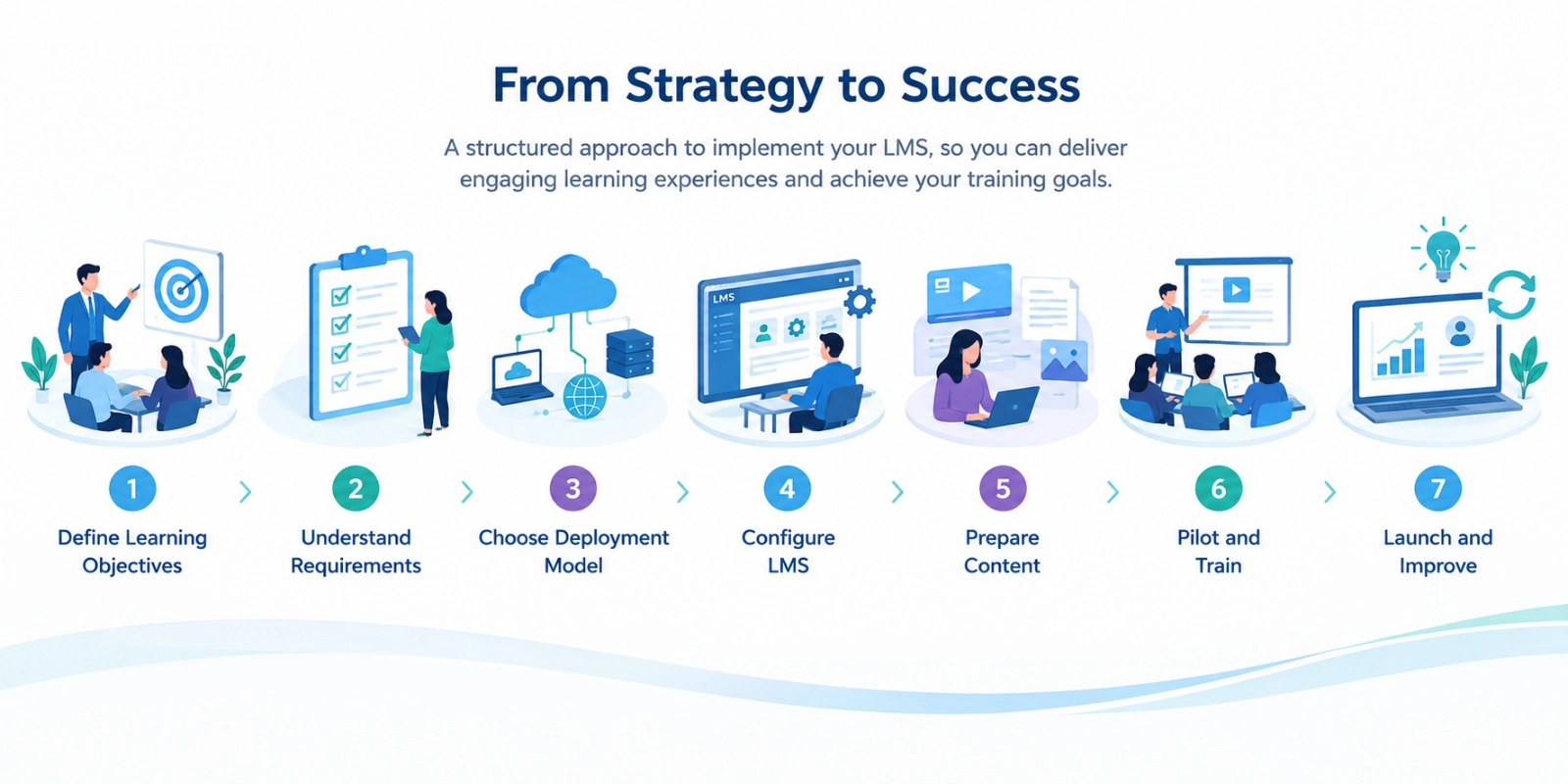
- Identify training objectives: Determine what the organisation wants to achieve, such as reducing classroom training costs, improving compliance tracking, standardising employee onboarding or delivering courses online.
- Define system requirements: Identify the number of learners, administrators and trainers, required LMS features, reporting needs, security requirements and integration with existing HR or business systems.
- Select the LMS deployment model: Decide whether a cloud-based SaaS LMS, a self-hosted platform or another deployment arrangement best fits the organisation's operational and technical requirements.
- Configure the platform: Set up user roles, departments, course categories, access permissions, branding, notifications, reporting and any required integrations.
- Develop and upload learning content: Prepare training materials, online courses, assessments and learning pathways. Existing documents, presentations and videos may be converted into structured digital learning content.
- Conduct pilot testing and user training: Test the system with a selected group of learners, trainers and administrators. Resolve issues and familiarise users with the platform before wider deployment.
- Launch and monitor performance: Roll out the LMS, monitor usage and course completion, collect feedback and improve the learning experience over time.
The implementation timeline depends on the number of users, complexity of the requirements, content readiness and integration scope. A basic cloud LMS deployment may be relatively straightforward, while an enterprise-wide implementation involving legacy system migration and multiple integrations will require more extensive planning.
What Are the Different Types of LMS Deployment?
Software-as-a-Service (SaaS) LMS
The LMS is hosted and maintained by the service provider and accessed through the internet.
- Lower upfront infrastructure requirements.
- Access through web browsers and compatible mobile devices.
- Software maintenance and updates are generally managed by the provider.
- Subscription pricing is commonly based on users, usage or selected features.
On-premises or self-hosted LMS
The LMS is deployed within the organisation's own infrastructure or hosting environment.
- Greater direct control over infrastructure and deployment configuration.
- May support specific internal hosting or integration requirements.
- Requires the organisation or its appointed service provider to manage infrastructure, maintenance and upgrades.
Hybrid LMS implementation
A hybrid approach combines cloud-based services with selected internally managed systems, integrations or learning environments. It may be considered when an organisation has existing systems that need to remain in place while introducing new digital learning capabilities.
There is no universal deployment model for all Singapore organisations. The choice should be based on the organisation's security requirements, IT architecture, budget, operational capacity, integration needs and long-term objectives.
What Features Should Organisations Look for in an LMS?
| Feature | Description |
|---|---|
| Course authoring | Create online courses, interactive lessons, quizzes and digital learning materials. |
| AI-powered content creation | Use AI to assist with course outlines, learning content, question generation and other instructional design tasks. |
| Learner and training management | Manage user accounts, course enrolments, training assignments and learning schedules. |
| Mobile learning | Allow learners to access courses using smartphones, tablets and computers. |
| Online and blended learning | Support self-paced learning, classroom training and virtual learning activities. |
| Assessment and competency management | Conduct examinations, assignments, practical assessments and skills-based evaluations. |
| Attendance tracking | Record and monitor attendance for relevant classroom and training sessions. |
| Learning analytics | Generate reports on training participation, completion, assessment results and learner performance. |
| Certification | Track course completion and support digital certificate issuance. |
| System integration | Connect with relevant HR, finance, identity management, TMS and other business systems. |
For training providers, additional consideration should be given to TPGateway integration, training administration, enrolment records and the data required for applicable funding processes.
A provider should verify the actual capabilities of each proposed LMS or TMS, rather than assuming that every platform supports all the listed functions.
LMS and TPGateway Integration in Singapore
What is TPGateway?
TPGateway is a one-stop portal for training providers and programme partners to access resources and digital services relating to Singapore's Training and Adult Education industry and relevant training grant administration.
For training providers receiving funding from SkillsFuture Singapore, an integrated TMS is used to facilitate the transfer of relevant training data to SSG's systems.
According to the published TPGateway guidance, the TMS requirement applies to relevant providers offering SSG-approved funded courses, subject to specified exemptions.
How does an LMS work with TPGateway?
| Component | Role |
|---|---|
| Learners, Trainers and Administrators | Access learning, course administration and assessment functions. |
| Integrated LMS / TMS | Course delivery, enrolment, attendance, assessment, training records and administration. |
| TPGateway and SSG systems | Relevant data exchange and training grant administration through supported integration interfaces. |
This is an illustrative system architecture. Actual integration scope and data flows depend on system configuration and applicable SSG requirements.
TPGateway's published information explains that training providers can connect their systems using application programming interfaces (APIs) to transmit information such as enrolment and training records.
An integrated LMS/TMS solution can therefore help training providers manage their learning activities and related administrative workflows within a connected environment.
However, having an LMS alone does not automatically establish compliance with all applicable SSG requirements. Training providers should confirm the system's supported integrations, required data sets, security arrangements and current requirements with the relevant authorities and system provider.
Official resources:
- TPGateway – Training Management System: https://www.tpgateway.gov.sg/resources/digitalisation/training-management-system
- TPGateway – Frequently Asked Questions: https://www.tpgateway.gov.sg/faq/about-tpgateway
How Much Does an LMS Cost in Singapore?
The cost of implementing an LMS in Singapore depends on the deployment model, number of users, required features, customisation and integration scope.
There is no single standard price for an LMS because different organisations have different training and technical requirements.
| Cost component | What it covers |
|---|---|
| Software subscription or licence | Access to the LMS platform and its features. |
| Implementation and configuration | Initial setup, user roles, branding, configuration and deployment. |
| Content development | Creating or converting learning materials, videos, interactive courseware and assessments. |
| Integration | Connecting the LMS to HR, finance, identity management, TMS or other systems. |
| Training and support | Administrator training, technical support, maintenance and ongoing assistance. |
A cloud-based LMS may use a subscription model, while self-hosted implementations may involve additional infrastructure, deployment and maintenance costs.
When comparing quotations, organisations should consider the total cost of ownership over the intended contract period, rather than comparing only the initial subscription or licence fee.
For training providers, the evaluation should also include the costs associated with TMS integration and any specialised training administration requirements.
Is an LMS Eligible for Government Funding in Singapore?
Organisations considering an LMS may also wish to investigate whether their proposed digitalisation or training project qualifies for available government support.
Singapore has various business support and workforce development schemes, but eligibility depends on the specific scheme, applicant, project scope and prevailing conditions.
Explore EDGE Grant Support for Your Digital Transformation
Singapore businesses may be eligible for EDGE Grant support when undertaking projects to improve efficiency, strengthen capabilities and adopt new digital solutions. With funding of up to 70% for eligible SMEs, the EDGE Grant can help reduce the cost of qualifying business transformation projects. Talk to Wizlearn to explore whether your training and learning management initiative may fit within the relevant grant-supported activities.
Enterprise Singapore – EDGE Grant: https://www.enterprisesg.gov.sg/financial-support/edge-grant
Note: Grant eligibility and support levels are subject to Enterprise Singapore’s prevailing criteria and approval.
SBF Digi-TAC funding
The Singapore Business Federation (SBF) provides information on TAC-related resources and digitalisation support initiatives for eligible Trade Associations and Chambers (TACs). TACs and their members should check the applicable programme requirements, participating solution providers, funding conditions and application process before committing to a project.
Singapore Business Federation – TAC Resources: https://www.sbf.org.sg/membership-tacs/tac-resources
Funding availability, support levels and qualifying conditions can change. The inclusion of an LMS in a project does not automatically mean that the software purchase or implementation will qualify for funding.
Organisations should confirm current eligibility and obtain the necessary approvals from the relevant programme administrator before proceeding.
How to Choose the Right LMS Provider in Singapore
Selecting an LMS provider is a long-term decision that can affect an organisation's training operations, employee development and digital learning strategy.
Before making a decision, organisations should evaluate the following considerations.
Industry experience: Does the provider understand the organisation's industry, training workflows and specific learning requirements?
Functional capabilities: Can the platform support course creation, learner management, assessments, reporting and the required training delivery methods?
Integration and interoperability: Can the LMS integrate with existing business systems and, where relevant, support the required TPGateway and TMS integration?
Security and data protection: Does the provider offer appropriate security controls, access management, data protection measures and hosting arrangements?
Scalability and flexibility: Can the system accommodate growth in learners, courses, departments and training requirements?
Local support and implementation services: Does the provider offer implementation assistance, administrator training, technical support and ongoing system maintenance?
Organisations should request a demonstration using realistic training scenarios, review the proposed implementation scope and obtain a clear breakdown of costs and responsibilities.
For larger projects, a pilot implementation can help validate the platform's suitability before a full organisation-wide rollout.
Frequently Asked Questions About LMS in Singapore
What is an LMS in simple terms?
An LMS is software that allows an organisation to create, deliver, manage and track training and learning activities online. It provides a central platform for learners, trainers and administrators.
Is an LMS compulsory in Singapore?
There is no universal requirement for every Singapore business to use an LMS. However, particular organisations and training providers may have specific training, recordkeeping or system requirements. Relevant SSG-funded training providers are subject to the applicable TMS integration requirements and exemptions.
What is the difference between LMS and TMS in Singapore?
An LMS focuses on learning delivery, course content, assessments and learner progress. A TMS focuses on training administration, including enrolments, scheduling, billing and grant-related processes. An integrated solution can support both functions.
Can an LMS integrate with TPGateway?
An LMS or TMS can potentially integrate with TPGateway through supported APIs, provided the system has the necessary data sets, security arrangements and integration capabilities. Training providers should verify the relevant requirements and supported integration scope.
Can an LMS be used for classroom training?
Yes. An LMS can support classroom training by managing pre-course materials, learner assignments, attendance workflows, assessments and post-training activities. This is often combined with face-to-face instruction in a blended learning model.
Is an LMS suitable for small businesses?
Yes. A cloud-based LMS can support small businesses that want to organise employee onboarding, compliance training and skills development without operating their own learning infrastructure. The appropriate solution depends on the number of learners, required features and budget.
How long does it take to implement an LMS?
The timeline varies according to the project scope, content readiness, number of users and integration requirements. A straightforward deployment can be completed more quickly than an enterprise-wide implementation involving system migration, extensive customisation and multiple integrations.
Conclusion
A Learning Management System plays an increasingly important role in helping Singapore organisations deliver structured training, develop workforce capabilities and manage learning activities digitally.
From corporate employee development and compliance training to continuing education, competency assessment and blended learning, an LMS provides the foundation for a more organised and measurable learning environment.
For training providers, the combination of an LMS and a suitable Training Management System can also support training administration and relevant government system integration requirements.
The key to a successful implementation is selecting a platform that aligns with the organisation's learning objectives, operational requirements, integration needs and long-term digitalisation strategy.
Official references
- Ministry of Manpower — establishment of SWDA
- TPGateway — TMS integration and exemptions
- TPGateway — frequently asked questions
Scheme rules, system interfaces and product configuration can change. Confirm current requirements with the relevant agency and verify the exact integration scope for your programme.
Explore Wizlearn’s LMS and TMS or contact the team about your requirements.